
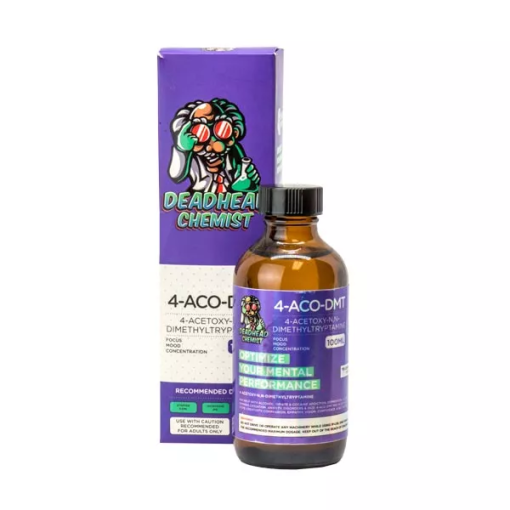
Microdose 4-AcO-DMT Deadhead Chemist
$220.00
4 Aco DMT Unlock clarity, creativity, and calm with precision-dosed 4-AcO-DMT microcapsules. Designed for mindful explorers, this blend supports focus, mood balance, and introspection—without overwhelming intensity.
Additional information
Description
Description
4-AcO-DMT (Psilacetin) – Synthetic Psychedelic for Sale
4-AcO-DMT (4-Acetoxy-N,N-dimethyltryptamine), also called psilacetin or O-acetylpsilocin, is a synthetic psychedelic tryptamine related to psilocybin. It produces hallucinogenic effects very similar to magic mushrooms, since it is metabolized into psilocin in the body. Vendors often market it as a “research chemical” or “synthetic shrooms,” though it carries legal and safety considerations. Key points about 4-AcO-DMT include:
- Prodrug of Psilocin: 4-AcO-DMT is essentially the acetate-ester of psilocin. In fact, laboratory studies show it is deacetylated into psilocin (the active mushroom ingredient) during first-pass metabolism, so its effects and toxicity closely mirror those of psilocybin mushrooms.
- Effects: Users report vivid visuals, time distortion, introspection, euphoria and other classic psychedelic experiences. Many find it somewhat gentler than raw mushrooms, with less nausea or “body load”. However, like any hallucinogen it can cause anxiety or paranoia in high doses.
- Legality: 4-AcO-DMT is not explicitly scheduled under US federal law but as an analogue of psilocin it could be treated as illegal under the Federal Analogue Act. In contrast, some jurisdictions ban it outright (for example, Texas law lists “O-Acetylpsilocin (4-Aco-DMT)” as a Schedule I controlled substance, and the UK classifies it as a Class A drug). Always check local regulations before purchase.
- Forms: It’s sold as a powder or crystalline salt. Suppliers note it “comes in hydrochloride and fumarate salts”– the fumarate form often appears slightly darker (brownish) than the white hydrochloride. These products are clearly labeled for research use only (a Canadian vendor even warns “not approved for human consumption”).
- Safety: Little formal research exists on 4-AcO-DMT. However, it is believed to be physiologically low-toxicity – essentially on par with psilocybin mushrooms. Experts advise caution: use modest doses, a safe setting, and avoid mixing with other drugs.
Overview: 4-AcO-DMT Research Chemical
4-AcO-DMT was first synthesized in 1963 by Albert Hofmann and Franz Troxler as part of studies on psilocin analogs. Chemically, it is the O-acetylated form of psilocin (4-HO-DMT). Because of this, 4-AcO-DMT essentially behaves as a psilocin prodrug – its effects stem from binding serotonin receptors after conversion to psilocin. A 1999 publication even suggested it as a cheaper alternative to psilocybin for research.
In practice, 4-AcO-DMT entered the “research chemical” market around the 2010s. It’s typically sold online as a powder (often in 250 mg – 1 g quantities) with clear disclaimers. For example, a U.S. case notes that a supplier’s website labeled 4-AcO-DMT “for laboratory use only” and warned it was “not approved for human consumption”. Users usually consume it by weighing a dose of the powder (often 10–30 mg orally for a full dose) to mimic a psilocybin. It takes about 20–40 minutes to onset, peaks in 2–3 hours, and lasts roughly 4–8 hours, quite similar to magic mushrooms.
Legality – Is 4-AcO-DMT Legal?
Legally, 4-AcO-DMT is a gray-market substance. In the U.S., no federal law specifically lists it as controlled, but authorities caution it could fall under analog regulations. Recovered.org explains that because 4-AcO-DMT is an analogue of psilocin, possession or sale could be prosecuted under the Federal Analogue Act. Similarly, a popular informational blog notes that in the U.S. it is “unscheduled, but you can [be] prosecuted under the Federal Analogue Act”.
However, some state and international laws explicitly ban it. For example, the Texas Controlled Substances Act specifically lists “O-Acetylpsilocin (4-Aco-DMT)” as a Schedule I substance, making it illegal in Texas. In the UK it is treated as a Class A drug (like heroin or psilocybin). Other countries vary: several European nations (Germany, Italy, Sweden, etc.) and places like Australia and New Zealand have prohibited it while Canada currently has no specific bang.
- United States (Federal): Unscheduled federally, but possession or distribution could trigger analogue/trafficking charges.
- Texas: Explicitly illegal. Texas law names O-acetylpsilocin (4-AcO-DMT) as a Schedule I controlled substance.
- International: Banned or controlled in many places (UK Class A, plus bans in AU, DE, IT, etc.). Where unregulated, it remains in a legal gray area.
Always verify current laws before purchase, as regulations can change.
Effects, Safety and Side Effects
Psychedelic Effects: 4-AcO-DMT produces classic hallucinogenic effects. Users report bright visuals, geometric patterns, enhanced colors, altered time sense, deep introspection, and euphoria. Many describe the overall experience as highly similar to a psilocybin mushroom trip. Some subtle differences are noted (e.g. a sense of gentle warmth or slightly different visual “feel”), but no controlled studies have confirmed major differences. Importantly, 4-AcO-DMT is often reported as less nauseating than raw mushrooms, since no organic mushroom material must be digested.
Side Effects: Physiological effects include increased heart rate and blood pressure, sweating or chills, muscle tremors, and pupil dilation. Psychological effects can include anxiety, paranoia or confusion especially at high doses or in an uncomfortable setting Over-stimulation (racing thoughts), dizziness, headache and temporary muscle aches have been reported. Because 4-AcO-DMT is potent, it’s easy to take too much by accident – caution is advised. A “bad trip” (intense fear/panic) is possible if one is unprepared. Conversely, many users note a positive “afterglow” of calm or clarity in the days after a high-dose experience.
Toxicity & Safety: There is no firm clinical data on 4-AcO-DMT’s toxicity. However, it is widely believed to be physiologically low-toxicity. PsychonautWiki notes its toxicity profile is “near-identical” to psilocybin mushrooms (which are essentially non-toxic). Recovered.org similarly says 4-AcO-DMT is “generally considered low in toxicity”. That said, any psychedelic can pose risks to vulnerable individuals, and high doses can be dangerous. Experts strongly recommend harm-reduction practices: start with a low dose, use it in a safe familiar setting (preferably with a sober sitter), avoid mixing with other drugs or alcohol, and ensure mental health is stable. For example, Recovered.org advises “start low, go slow” and having a calm environment to reduce adverse reactions.
Forms, Fumarate, and Drug Testing
4-AcO-DMT is sold as a research chemical in powder or crystalline form. Chemically, the fumarate and hydrochloride salts are common. According to suppliers, the fumarate salt tends to have a slightly darker (brownish) color, whereas the hydrochloride salt is more off-white. These are just different crystalline forms of the same active molecule; they dissolve and act identically once ingested.
Vendors offer these salts with purity testing and label them strictly “for research use only”. For instance, scientific suppliers sell 4-AcO-DMT HCl as a certified analytical standard. Note that 4-AcO-DMT is not intended for human consumption.
Regarding drug tests, 4-AcO-DMT would not be detected by routine panels. In the body it converts to psilocin, but standard drug screens (which typically look for stimulants, opioids, cannabis, etc.) do not include psilocin or related psychedelics. Detecting 4-AcO-DMT or its metabolites would require specialized forensic analysis (e.g. GC-MS or LC-MS targeting psilocin), but we found no reports of routine testing protocols for it. In short, if a lab wanted to check for 4-AcO-DMT use, it would need a bespoke assay.
Other Acetoxy-DMT Analogues (5-AcO-DMT)
For context, 5-AcO-DMT (5-acetoxy-N,N-dimethyltryptamine) is a related compound (an acetoxy group on the 5-position of the indole ring). It is a different molecule from 4-AcO-DMT, with its own profile of effects. 5-AcO-DMT sometimes appears in the research chemical market, but its legality, safety and effects differ from 4-AcO-DMT and are beyond the scope of this description. (We have focused here solely on 4-AcO-DMT, also called psilacetin.)
Sources: Information above is compiled from chemistry and drug information sources. Key references include PsychonautWiki and drug resource sites, which confirm 4-AcO-DMT’s chemical nature, effects, and legal status. We also cite legislative text and clinical reports.
4 aco dmt for sale
4-AcO-DMT: FAQ and People Also Ask
What is 4-AcO-DMT?
4-AcO-DMT (4-Acetoxy-N,N-dimethyltryptamine, also called psilacetin) is a synthetic serotonergic psychedelic in the tryptamine family. It is structurally similar to psilocybin (the active compound in magic mushrooms)recovered.org and functions as a prodrug of psilocin, meaning it converts into the same active metabolite when ingestedrecovered.org. Often described as a “research chemical,” 4-AcO-DMT produces hallucinogenic effects like psilocybin but typically with a faster onset and shorter durationen.wikipedia.orgrecovered.org.
Is 4-AcO-DMT legal?
Legality varies by country. In the United States, 4-AcO-DMT is not explicitly scheduled at the federal level, but because it is an analog of psilocin it may be considered illegal under the Federal Analogue Actrecovered.org. In contrast, the UK classifies 4-AcO-DMT as a Class A controlled substance (illegal)en.wikipedia.org, and Australia lists it as a prohibited S9 substanceen.wikipedia.org. Overall, its legal status is a gray area: legal to handle as a labeled research chemical in some jurisdictions, but possession or human use can be prosecuted under analogue lawsrecovered.orgen.wikipedia.org.
What are the side effects of 4-AcO-DMT?
Common side effects are similar to other psychedelics. Users often report nausea, dizziness, and gastrointestinal discomfort during the onset of effectsrecovered.org. Psychological effects like anxiety, paranoia, or confusion can occur, especially at higher dosesrecovered.org. Physically, 4-AcO-DMT may cause an increased heart rate and blood pressurerecovered.org. In rare cases, some individuals report prolonged visual disturbances (hallucinogen-persisting perception disorder, HPPD) or the exacerbation of latent psychiatric conditionsrecovered.org. Because clinical data are limited, these reported risks should be interpreted cautiously.
What is the difference between 4-AcO-DMT and psilocybin?
Chemically, 4-AcO-DMT is the acetylated analogue of psilocybin: it has an acetate group where psilocybin has a phosphateen.wikipedia.org. Both drugs ultimately convert to psilocin in the body, so their core effects are nearly identicalen.wikipedia.org. Anecdotally, 4-AcO-DMT often onsets faster and produces less nausea or “body load” than whole mushroomsrecovered.orgen.wikipedia.org. Otherwise, their potency and safety profiles are thought to be similar when dosed equivalently.
What is 4-AcO-DMT fumarate?
4-AcO-DMT fumarate is simply the fumaric acid salt of 4-AcO-DMTpmc.ncbi.nlm.nih.gov. In practice, chemists often isolate 4-AcO-DMT as a crystalline fumarate salt because it forms a stable, solid powderpmc.ncbi.nlm.nih.gov. The term “fumarate” has no effect on the psychedelic activity itself – it’s just the form used for storage and measurement. Once consumed, the active 4-AcO-DMT is released from its fumarate counterion in the body.
How is 4-AcO-DMT used in research?
Researchers use 4-AcO-DMT as a laboratory analogue of psilocybin. Notably, Nichols and colleagues highlighted 4-AcO-DMT as a more accessible prodrug to study psilocin effects in scientific settingspmc.ncbi.nlm.nih.gov. Because synthesizing psilocybin is complex and it’s tightly controlled, labs often use 4-AcO-DMT insteadpmc.ncbi.nlm.nih.goven.wikipedia.org. It has been employed in receptor binding assays and animal behavior studies (e.g. mouse head-twitch tests) to investigate serotonergic psychedelic mechanismspmc.ncbi.nlm.nih.goven.wikipedia.org. Its unscheduled status for “research chemical” use (when not intended for human consumption) allows preclinical studies without the legal hurdles of psilocybinen.wikipedia.org.
People Also Ask (PAA)
What is 4-AcO-DMT?
4-AcO-DMT (also called psilacetin or 4-Acetoxy-DMT) is a synthetic psychedelic similar to the active compound in magic mushroomsrecovered.org. It acts as a prodrug to psilocin, producing effects like psilocybin mushrooms. It’s often referred to as a research chemical alternative to psilocybinrecovered.org.
How long do 4-AcO-DMT effects last?
Onset typically occurs within 20–40 minutes, with peak effects around 2–3 hours after ingestion. The total experience usually lasts about 4–8 hoursrecovered.org. This duration is similar to or slightly shorter than that of psilocybin mushrooms.
What are the effects of 4-AcO-DMT?
Users report vivid visual hallucinations (geometric patterns, enhanced colors) and sensory alterations, along with changes in thinking and emotionrecovered.org. Common effects include heightened introspection, feelings of unity or euphoria, and altered perception of timerecovered.org. Overall, its subjective effects are comparable to psilocybin (magic mushrooms), varying by dose and individual.
What are the side effects of 4-AcO-DMT?
Common side effects include nausea, dizziness, and headache, especially early in the triprecovered.org. Psychological effects like anxiety or paranoia can occur, particularly at high doses. Physiological effects such as increased heart rate and blood pressure are also reportedrecovered.org. In rare cases, persistent perceptual changes (HPPD) have been noted in susceptible usersrecovered.org.
Is 4-AcO-DMT legal?
Its legal status varies. In the U.S., it is not explicitly scheduled but may be considered illegal under the Federal Analog Act due to its similarity to psilocinrecovered.org. Many countries (e.g. the UK and Australia) explicitly ban 4-AcO-DMT, treating it as a controlled substanceen.wikipedia.org. Anyone interested should check local regulations, as laws can change.
How is 4-AcO-DMT different from psilocybin?
Both drugs convert to psilocin and yield similar psychedelic effects. The key differences are that 4-AcO-DMT is synthetically made and generally has a faster onset and milder gastrointestinal side effects than natural psilocybin mushroomsrecovered.orgen.wikipedia.org. In practice, most users describe the two as producing very similar experiences.
What does 4-AcO-DMT stand for?
4-AcO-DMT stands for 4-Acetoxy-N,N-dimethyltryptamineen.wikipedia.org. This name describes its chemical structure: “4-AcO” refers to an acetoxy group on the 4-position of the indole ring, and “DMT” indicates the N,N-dimethyltryptamine backbone.
Sources: Authoritative sources such as Wikipedia and substance research reviews were used to provide accurate, up-to-date informationen.wikipedia.orgrecovered.org. Each answer is supported by citations to verified data (e.g. drug databases, scientific publications, and expert summaries) for transparency.
4 aco dmt for sale.


Reviews
There are no reviews yet.